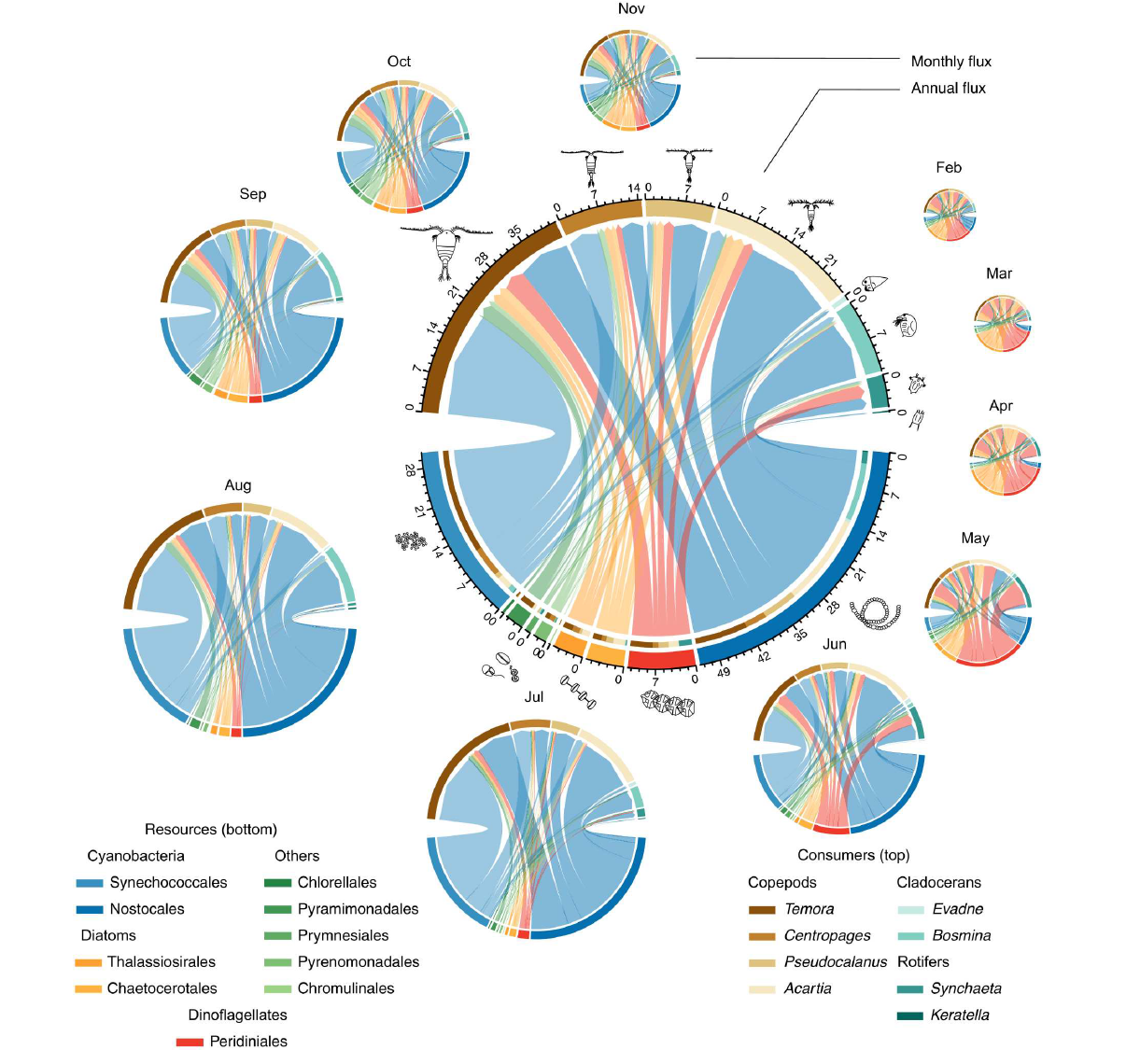
In this study we used data from dietary metabarcoding studies of zooplankton to calculate prey selectivity indices and assess energy fluxes in a pelagic resource-consumer network. We show that food web dynamics are influenced by prey selectivity and temporal match-mismatch in growth cycles and that cyanobacteria are the main source of primary production in the investigated coastal pelagic food web. The latter challenges the common assumption that cyanobacteria are not supporting food web productivity, a result that is increasingly relevant as global warming promotes cyanobacteria dominance. While this study provides a method for how DNA metabarcoding can be used to quantify energy fluxes in a marine food web, the approach presented here can easily be extended to other ecosystems.
Fig. 2. Consumer-resource network of the pelagic Baltic Sea. Link width is proportional to fluxes of energy (kJ/m2) between resources (phytoplankton, bottom) and consumers (zooplankton, top). The width of the nodes (taxa) corresponds to each population’s contribution to annual secondary production. The diameter of each plot is proportional to the square root of the total production.
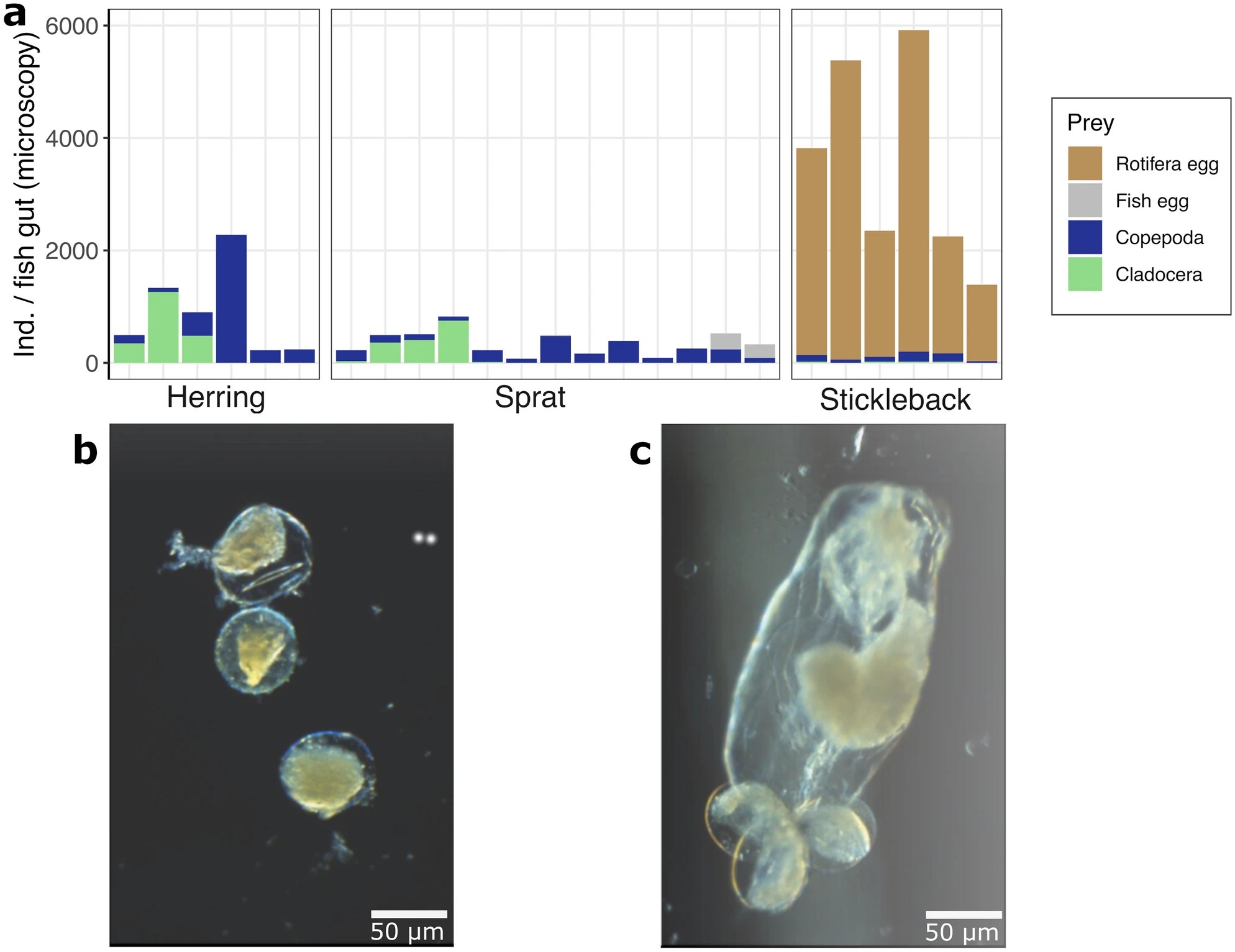
Here, we investigate diet overlap between these three planktivorous fishes in the Baltic Sea, utilizing DNA metabarcoding on the 18S rRNA gene and the COI gene, targeted qPCR, and microscopy. Our results show niche differentiation between clupeids and stickleback, and highlight that rotifers play an important role in this pattern, as a resource that is not being used by the clupeids nor by other zooplankton in spring. We further show that all the diet assessment methods used in this study are consistent, but also that DNA metabarcoding describes the plankton-fish link at the highest taxonomic resolution. This study suggests that rotifers and other understudied soft-bodied prey may have an important function in the pelagic food web and that the growing population of pelagic stickleback may be supported by the open feeding niche offered by the rotifers.
Figure 4: (a) Microscopic count of gut content of the planktivorous fish. Rotifers were identified as rotifer eggs. (b) Eggs were observed in the gut content of stickleback, originating from the rotifer genus Synchaeta. (c) Female of the rotifer genus Synchaeta carrying three eggs as identified from water samples. Scales are the same for (b) and (c). Source: https://www.nature.com/articles/s41598-022-15116-7/figures/4
Project description The Department of Ecology, Environment and Plant Sciences invites applications for a four-year PhD position part of the project ‘Drivers and functions of protist parasites in plankton food webs’. The goal of this PhD project is to resolve drivers and functions of parasites in structuring zooplankton populations and consequences for ecosystem function using novel molecular tools. Marine plankton, consisting of myriad small organisms form complex interaction networks that guarantee ecosystem function, have crucial roles for the global biogeochemical cycles and the productivity of ecosystems.
Current research emphasizes that besides feeding interactions, symbiotic interactions, especially parasitism are prominent in plankton communities. Parasites have major impacts on the ecology and evolution of their host populations, sometimes with consequences for ecosystem-level processes. Yet, plankton parasite interactions remain largely undescribed, mainly because they are difficult to identify, often hidden within their hosts, and as a consequence frequently overseen. This project will contribute to a quickly emerging research field and investigate an overlooked food-web link in the Baltic Sea, namely zooplankton-parasitic interactions across a wide range of host species and environmental gradients.
The student will identify host-specific parasite infections using novel metabarcoding, flow cytometry and microscopy, while experiments will provide novel contribution for host fitness consequences. The research will be performed at Stockholm University within the Department of Ecology, Environment and Plant Sciences with opportunities to collaborate with other PhD students.
We are looking for a highly motivated and self-directed student with a strong interest in general ecological questions and great enthusiasm for scientific work. Ideally, the student will have knowledge in plankton ecology, experience in molecular analysis, organism culturing and field sampling. Good data analysis skills or modelling, excellent interpersonal and communication skills, a strong sense of determination to succeed, and the ability to express his or her ideas in English is further expected. The applicants should be willing to travel and spend periods in the field.
Qualification requirements In order to meet the general entry requirements, the applicant must have completed a second-cycle degree, completed courses equivalent to at least 240 higher education credits, of which 60 credits must be in the second cycle, or have otherwise acquired equivalent knowledge in Sweden or elsewhere.
In order to meet the specific entry requirements, the general syllabus for doctoral studies in the field of Marine Biology stipulates, that applicants must have completed at least 60 higher education credits in the second cycle of which 15 credits must be from a course in Marine Biology, and 30 credits from a project in Marine Biology. Applicants may also have otherwise acquired equivalent knowledge in Sweden or elsewhere.
The qualification requirements must be met by the deadline for applications.
Please visit the following site for more information and application for the position:
It is exciting that the Swedish Research Council has granted us funding for four years to continue our work on drivers and functions of plankton interactions. This specific project will investigate the role of parasitic symbionts in the functioning and equilibrium of carbon flow in marine food webs. We aim to resolve drivers and functions of parasite in structuring zooplankton populations and consequences for ecosystem functioning, in particular the way parasites are selectively favoured, parasite host range and effects on host fitness. We will soon advertise a position to work on this project, so stay tuned.
Alternative pathways of energy transfer guarantee the functionality and productivity in marine food webs that experience strong seasonality. Nevertheless, the complexity of zooplankton interactions is rarely considered in trophic studies because of the lack of detailed information about feeding interactions in nature.
In this study, we used DNA metabarcoding to highlight the diversity of trophic niches in a wide range of micro- and mesozooplankton, including ciliates, rotifers, cladocerans, copepods and their prey, by sequencing 16- and 18S rRNA genes. Our study demonstrates that the zooplankton trophic niche partitioning goes beyond both phylogeny and size and reinforces the importance of diversity in resource use for stabilizing food web efficiency by allowing for several different pathways of energy transfer. We further highlight that small, rarely studied zooplankton (rotifers and ciliates) fill an important role in the Baltic Sea pelagic primary production pathways and the potential of ciliates, rotifers and crustaceans in the utilization of filamentous and picocyanobacteria within the pelagic food web. The approach used in this study is a suitable entry point to ecosystem-wide food web modelling considering species-specific resource use of key consumers.
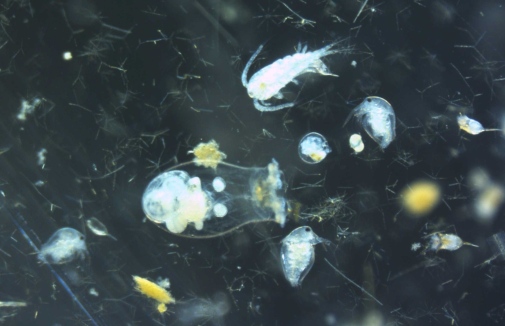
A large rotifer of the genus Asplanchna, surounded by three cladocerans, Bosmina. Top: A copepodite (juvenile copepode). Right: two rotifers, Keratella. The background is scattered with diatoms. Photo: Andreas Novotny.
The Department of Ecology, Environment and Plant Sciences invites applications for a four-year PhD position part of the project ‘Plankton-fish interactions: An understudied link in Baltic Sea food webs and fisheries management’. The goal of this PhD project is to investigate prey preference of small pelagic fish including the entire prey spectrum using novel molecular tools that amplify and sequence low levels of DNA combined with network models to project trophic coupling under changing climate, nutrient and fisheries scenarios. Small-sized pelagic fish have a central role in marine food webs as they control production of predatory fish and at the same time feed on zooplankton and thereby indirectly control algal blooms. Understanding variation in plankton-fish feeding interactions are key for developing management strategies that promote fish stocks and enhance control on algal blooms, which requires detailed knowledge about feeding interactions from primary producers to upper trophic levels. Results of this project will be of relevance to better understand temporal and spatial dynamics of fish feeding, growth and recruitment, which is important to advice ecosystem management for sustainable fisheries and prevention of algal blooms.
The student will conduct field surveys in the Baltic Sea, laboratory experiments, molecular analysis, including DNA sequencing, bioinformatics and network modelling. The research will be performed at Stockholm University within the Department of Ecology, Environment and Plant Sciences with opportunities to collaborate with other PhD students and to participate in international collaborations.
We are looking for a highly motivated and self-directed student with a strong interest in general ecological questions and great enthusiasm for scientific work. Ideally, the student will have knowledge in plankton or fish ecology, experience in molecular analysis, organism culturing and field sampling. Good data analysis skills or modelling, excellent interpersonal and communication skills, a strong sense of determination to succeed, and the ability to express his or her ideas in English is further expected. The applicants should be willing to travel and spend periods in the field.
For more information and submission of your application, please see
Two master students finished their projects in Dec 2020:
Calum Young:Examination of plankton communities, invaders and harmful algal species within mangrove areas of the Galápagos Islands using eDNA metabarcoding
Phytoplankton are critical components of the marine environment but their understanding within the Galápagos Marine Reserve (GMR) remains largely underexplored with research focused within mangrove systems being further limited. Between November and December, the Galápagos Islands transition from the dry, milder season to the wet, warmer season. By examining the dominant phytoplankton genera within mangrove communities during this time, inference can be made on the communities’ responsiveness to seasonal change. This study utilised environmental DNA (eDNA) metabarcoding of the 18S ribosomal RNA (rRNA) molecular marker to survey the micro-eukaryotic community in surface waters collected from six mangrove sites. Compositions were shown to be influenced by both spatial conditions and seasonality. Diatoms represented a significant proportion of the community and were shown to undergo a strong seasonal shift to dominance by smaller sized taxa, possibly due to their efficient nutrient acquisitional traits. Dominance within dinoflagellates appeared dependent on several eco-physiological strategies; with parasitism and endosymbiosis appearing most advantageous for community dominance.
Mangrove communities were also examined for invasive and toxic algae species. These groups represent an area of growing concern within the region and exploration of their distribution within the GMR has not previously been conducted using metabarcode sequencing. Here, several new observations of invasive species for the GMR are reported. Additionally, a range of toxin-producing algal species was also detected. However, for both groups, the respective relative abundance of individual species within mangroves communities was minimal. Sites located closer to human activity did not appear to be more impacted by problem species than more isolated areas. The low proportion held by harmful groups is encouraging, but the diversity of species detected warrants improved monitoring to ensure populations and their associated negative impacts remain negligible.
Vivien Holub: Connectivity through larval dispersal in Kenya and Tanzania: A hydrodynamic connectivity model of marine protected areas
Marine protected areas (MPAs) are considered as major conservation tools and have been implemented globally to protect marine biodiversity and to support the sustainability of coastal fisheries. Following scientific guidelines, conservation efforts also aim to establish representative MPA networks at various spatial scale, which is expected to enhance the efficiency of individual areas. Yet, degree at which MPA populations are potentially connected by the dispersal of marine organisms remain largely unknown. To address this knowledge gap, the present study investigates connectivity patterns among Kenyan and Tanzanian MPAs (between 0 – 10 and 38 – 47 ) in the Western Indian Ocean, a region where food and livelihood security are highly dependent on coastal fisheries. Interconnectedness is evaluated through a hydrodynamic larval dispersal model parameterized for the seagrass parrotfish Leptoscarus vaigiensis, a heavily targeted fish species by small-scale fisheries in the region. Applying graph theory and various connectivity metrics, this study shows that the Kenyan-Tanzanian MPAs form a weakly connected network where connections are the strongest in the Tanzanian Tanga and Zanzibar region and weakest in the northmost Kenyan MPAs. Poor coherency is likely the result of the predominantly northwardly flow of the regional East African Coastal Current which generates and imbalance of larval migration rate between MPAs on a latitudinal scale. Although connectivity patterns are significantly stronger when the dominant current is temporarily weakened and deflected in North Kenya during NEM season, on average the strength of connectivity remains low. Therefore, the present investigation demonstrates that the regional hydrodynamic patterns poses a challenge for achieving effective MPA network. Continued studies with more conservative model conditions is recommended. However, based on its findings, this study suggest that local governments further increase MPA surface coverage and consider a cross-boundary management of MPAs to improve connectivity.
Although parasitism is one of the most prevalent interactions in nature, studies of aquatic food webs rarely include parasites. Syndiniales (Dinophyceae, Alveolata) is a diverse parasitic group of dinoflagellates, common in all marine environments, and are described as dominant components of pelagic ecosystems. However, their temporal dynamics, prevalence, and host-specificity are poorly known. Using DNA metabarcoding to explore trophic interactions of zooplankton, we found a high proportion of Syndiniales sequence reads associated with the targeted consumers. We observed the occurrence of Syndiniales in copepods, cladocerans, appendicularians, and polychaete larvae, ranging between 11 and 36% relative read abundance, encompassing 11 main putative clades. Zooplankton–Syndiniales interactions showed variability in occurrence across the taxa, but also certain host-specificity. The study suggests that the observed copepod–Syndiniales interactions can be both direct parasitic infections and the result of trophic transmission through potentially infected prey by Syndiniales. Our findings emphasize that their interactions should be recognized as key players in the structure and connectivity of plankton food webs.
Schematic representation of potential host-parasite interactions between copepods and Syndiniales based on results from this study and literature information. *Lima-Méndez et al. 2015 and Sassenhagen et al. 2020; **Clarke et al. 2019; ***Cachon 1964 and Sassenhagen et al. 2020




 Winder Lab