DNA metabarcoding reviels limited resource overlap among small pelagic fishes

A new study shows that resource use overlaps among herring, sprat and three-spined stickleback are limited in the Baltic Sea and varied with prey availability. We assessed diet composition in May and October using DNA metabarcoding, stable isotopes, and microscopy. All three methods gave consistent results.

The clupeids shared a similar diet in May when prey diversity was low, composed mainly of the copepods Pseudocalanus and Acartia, whereas three-spined stickleback favoured different copepod species and the rotifer Synchaeta, which was confirmed by a different isotopic value as compared to the two clupeids. In October, all forage fish preyed on diverse zooplankton species, mainly composed of the copepods Acartia, Eurytemora, and Temora, while Pseudocalanus was only important for herring. The observed resource use partitioning between sprat and herring was confirmed by the stable isotope values from October, suggesting that different prey species were targeted during the summer period.

This study suggests that shifts in zooplankton dynamics, rather than competition for resources, have the potential to drive small pelagic fish population fluctuations.

Find the full publication at:

Kinlan M G Jan, Jonas Hentati-Sundberg, Niklas Larson, Monika Winder, Limited resource use overlaps among small pelagic fish species in the central Baltic SeaICES Journal of Marine Science, Volume 82, Issue 9, September 2025, fsaf122, https://doi.org/10.1093/icesjms/fsaf122

Figure 4. Prey selectivity for herring, sprat, and three-spined stickleback. The link widths are proportional to the average Chesson index for each fish species in May (a, b) and October (c, d) based on the 18S (a, c) and COI (b, d) reads. Asterisks represent prey taxa observed only in one season for each barcode.
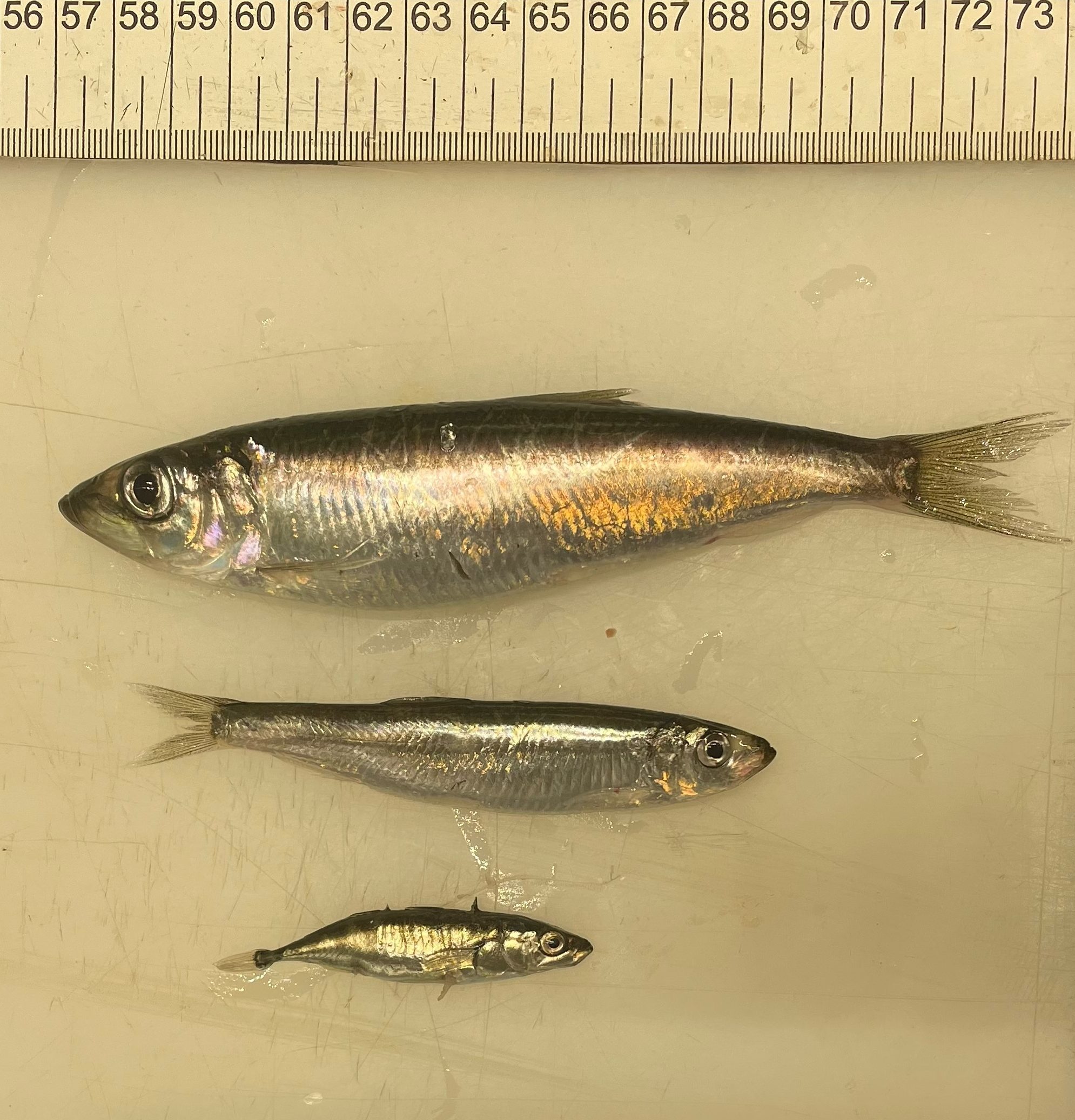
Herring, sprat and three-spine stickleback; Foto: Jan Kinlan

New study shows seasonal diversity and distribution of fish larvae in seagrass habitats of coastal East Africa

Here we investigated drivers of the seasonal fish larvae abundance and composition in seagrass habitats in coastal Kenya and Tanzania. We found a high diversity of fish larvae (54 families) inhabiting seagrass habitats that differed between sites and seasons. Overall, total larval abundances per site were low, likely related to the low productivity and strong hydrodynamic processes in this region. Our data suggests that most of the fish spawn year-round in these tropical waters as we did not find strong seasonal patterns. All sites had a high relative abundance of larvae from demersal spawning fishes, indicating that many fish species move to coastal sites for spawning. Primary productivity and dissolved oxygen, driven by hydrodynamics conditions are positively related to fish larvae productivity both in Kenya and Tanzania. These findings indicate that the occurrence of both resident and transient fish larvae in seagrass meadows is driven by strong hydrodynamic and tidal processes that transport fish larvae across adjacent habitats.

The full article is available here:

Ngisiange, N., Tarimo, B., Daudi, L. et al. Seasonal fish larvae abundance and composition in seagrass habitats of coastal East AfricaSci Rep 14, 11203 (2024). https://doi.org/10.1038/s41598-024-62012-3

Just out – new paper on plankton phenology

Here we analyzed 15 yr of monitoring data to identify trends and drivers of timing and magnitude of bloom-forming phytoplankton and diverse zooplankton taxa throughout the season in the central Baltic Sea.

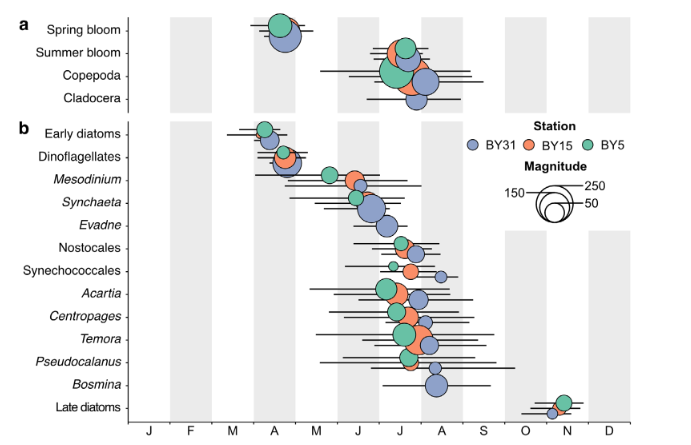
We show that the timings of phytoplankton blooms advance, whereas crustacean zooplankton seasonal timings remain constant. This increasing offset with the spring bloom is linked to the decline of Pseudocalanus, a key copepod sustaining pelagic fish production. The majority of copepod and cladoceran taxa, however, are co-occurring with summer blooms. We also find new developing fall blooms, fueling secondary production later in the season. Our study highlights that response to climate change differs within and between functional groups, stressing the importance of investigating plankton phenologies over the entire annual cycle in pelagic systems.

See also SU’s press release:

English: Earlier spring bloom disrupt the balance of the Baltic Sea

Swedish: Allt tidigare algblomningar rubbar den känsliga balansen i Östersjön

The full article is available here: Plankton blooms over the annual cycle shape trophic interactions under climate change. Limnology and Oceanography Letters

Plankton succession in the central Baltic Sea from 2008 to 2022. Seasonal timing, peak magnitude and bloom duration of (a) total spring and summer phytoplankton and total copepod and cladoceran biomass, and (b) dominating phytoplankton and zooplankton taxa. Point positions (x-axis) correspond to the average peak timing (week), point sizes to the average peak magnitude (zooplankton: μg L−1; phytoplankton: μg C L−1) and the horizontal bars to the average initiation and termination (week) of their respective growing seasons.

Dynamics of Gut Bacteria Across Different Zooplankton Genera

Zooplankton-associated bacteria potentially have a great impact on the structure of ecosystems and trophic networks by providing various metabolic pathways and altering the ecological niche of host species. To understand the composition and drivers of zooplankton gut microbiota, we investigated the associated microbial communities of four zooplankton genera from different seasons in the Baltic Sea using the 16S rRNA gene.

Among the 143 ASVs (amplified sequence variants) observed belonging to heterotrophic bacteria, 28 ASVs were shared across all zooplankton hosts over the season, and these shared core ASVs represented more than 25% and up to 60% of relative abundance in zooplankton hosts but were present at low relative abundance in the filtered water. Zooplankton host identity had stronger effects on bacterial composition than seasonal variation, with the composition of gut bacterial communities showing host-specific clustering patterns. Our results suggest that the patterns of gut bacteria dynamics are host-specific and the variability of gut bacteria is not only related to host taxonomy but also related to host behavior and life history traits.

The study is available here: Xu, T., Novotny, A., Zamora-Terol, S., Hambäck, P., Winder, M. Dynamics of Gut Bacteria Across Different Zooplankton Genera in the Baltic Sea. Microb Ecol 87, 48 (2024). https://doi.org/10.1007/s00248-024-02362-7

Figure: Relative abundance of shared and core ASVs compared to water (inner ring). a Relative abundance of shared ASVs present in all zooplankton hosts across months at class level (outer rings) compared to water. b Relative abundance of core ASVs across months (outer ring) for each zooplankton host and their relative abundance in water samples (inner ring)

New study shows that climate change affects the activation of plankton resting stages with consequences for community composition and trophic mismatch

A large majority of plankton species overwinter as resting stage in the sediment. The resting life stage is, however, often overlooked in climate change research, although emergence of planktonic organisms originating from resting stages from the sediment is a key driver for pelagic population dynamic and community composition.

Here we ask to what extent the recruitment of plankton resting stages is affected by proposed climate change. For this, we investigated  phyto- and zooplankton recruitment from oxic sediments in the Baltic Sea in a controlled experiment under proposed temperature and light increase during the spring and summer. 

We find that emergence of resting stage differs between seasons and the abiotic environment. Phytoplankton recruitment from resting stages were high in spring with significantly higher emergence rates at increased temperature and light levels for dinoflagellate and cyanobacteria than for diatoms, which had highest emergence under cold and dark conditions. In comparison, hatching of copepod nauplii was not affected by increased temperature and light levels. These results show that activation of plankton resting stages are affected to different degrees by increasing temperature and light levels, indicating that climate change affects plankton dynamics through processes related to resting stage termination with potential consequences for bloom timing, community composition and trophic mismatch.

You can find the full article here:

Hedberg P, Olsson M, Höglander H, Bruchert V, Winder M (2024) Climate change effects on plankton recruitment from coastal sediments. Journal of Plankton Research. https://doi.org/10.1093/plankt/fbad060

Investigating recruitment of resting stages from Baltic Sea sediments. Foto: Per Hedberg.

The introduced Arapaima gigas in the Bolivian Amazon: Trophic position and isotopic niche overlap with native species

In this study we assess the potential impact of the introduced Arapaima gigas on native fish assemblages in two oxbow lakes of the Bolivian Amazon. Stable isotope data were used to determine trophic position (TP) and isotopic niche overlap, to evaluate potential predation and competition interactions, respectively. Results suggest that A. gigas is more an omnivore than a top predator, as often claimed. Arapaima gigas occupied an intermediate TP between detritivore/herbivore and piscivore fish species and showed broader isotopic niche compared to most native species analysed. Increasing our understanding on the processes generating impact of these introductions on resident communities through food web ecology will pave the way for better resource management and conservation efforts.

Read the full article here 

https://onlinelibrary.wiley.com/doi/full/10.1111/eff.12734

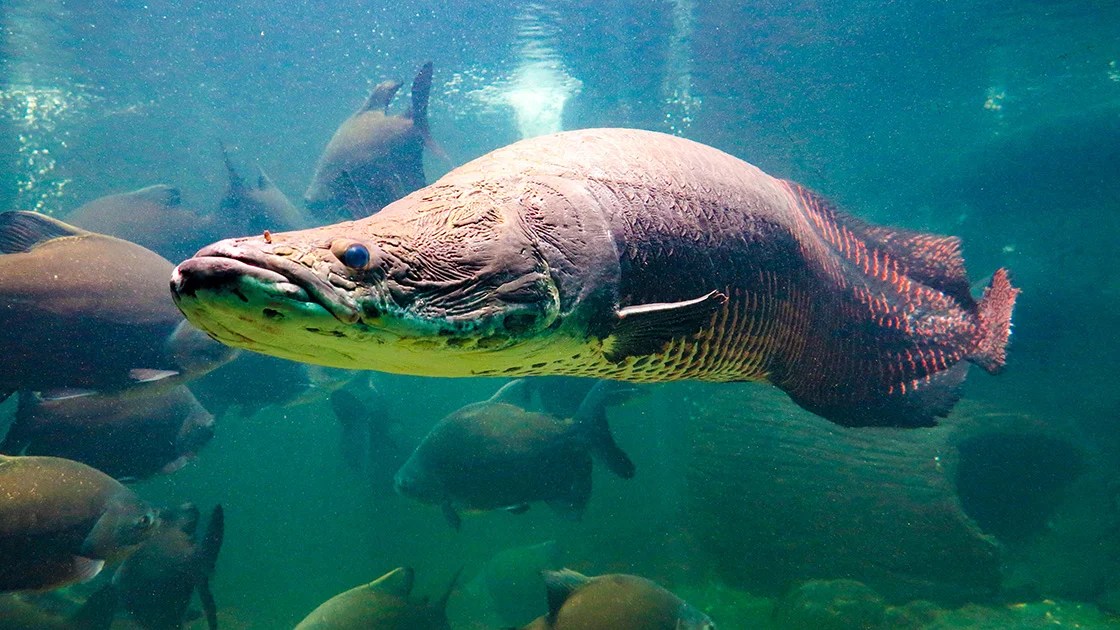
Arapaima is the largest freshwater fish with scales, home to the tropical waters of the Amazon basin.

Arapaima is the largest freshwater fish with scales, home to the tropical waters of the Amazon basin.

New study shows that trophic transfer of essential nutrients is complex

Variation in fatty acid content among benthic invertebrates in a seasonally driven system

Read the full study in Limnology and Oceanography Letter.

In this study we test whether the succession from nutritious spring blooms to summer cyanobacteria is reducing food quality for benthic primary consumers and their fatty acid (FA) profiles. Contrary to expectations, we find low seasonal variability in FA content of five benthic macroinvertebrates spanning two trophic levels in the Baltic Sea, a system with high seasonal variation in phytoplankton species composition. However, levels of the major FA groups vary greatly between benthic species. This suggests that seafloor animals have evolved mechanisms to adapt to low-quality food inputs and that species composition of seafloor animals is important for determining food quality for fish. Moreover, this indicates that the transfer of essential biomolecules from primary producer to upper trophic levels is more complex and not directly related to the taxonomic composition and content of phytoplankton. 

(A) Seasonal averaged content of PUFAs (including EFAs and their precursors ALA and LIN). The number reports the ω3:ω6 PUFA ratio. (B) NMDS clustering of benthic macroinvertebrate species, sediment and seston based on the proportion of individual FAs over the whole sampling period.

Figure (A) Seasonal averaged content of PUFAs (including EFAs and their precursors ALA and LIN). The number reports the ω3:ω6 PUFA ratio. (B) NMDS clustering of benthic macroinvertebrate species, sediment and seston based on the proportion of individual FAs over the whole sampling period.