DNA metabarcoding reviels limited resource overlap among small pelagic fishes

A new study shows that resource use overlaps among herring, sprat and three-spined stickleback are limited in the Baltic Sea and varied with prey availability. We assessed diet composition in May and October using DNA metabarcoding, stable isotopes, and microscopy. All three methods gave consistent results.

The clupeids shared a similar diet in May when prey diversity was low, composed mainly of the copepods Pseudocalanus and Acartia, whereas three-spined stickleback favoured different copepod species and the rotifer Synchaeta, which was confirmed by a different isotopic value as compared to the two clupeids. In October, all forage fish preyed on diverse zooplankton species, mainly composed of the copepods Acartia, Eurytemora, and Temora, while Pseudocalanus was only important for herring. The observed resource use partitioning between sprat and herring was confirmed by the stable isotope values from October, suggesting that different prey species were targeted during the summer period.

This study suggests that shifts in zooplankton dynamics, rather than competition for resources, have the potential to drive small pelagic fish population fluctuations.

Find the full publication at:

Kinlan M G Jan, Jonas Hentati-Sundberg, Niklas Larson, Monika Winder, Limited resource use overlaps among small pelagic fish species in the central Baltic SeaICES Journal of Marine Science, Volume 82, Issue 9, September 2025, fsaf122, https://doi.org/10.1093/icesjms/fsaf122

Figure 4. Prey selectivity for herring, sprat, and three-spined stickleback. The link widths are proportional to the average Chesson index for each fish species in May (a, b) and October (c, d) based on the 18S (a, c) and COI (b, d) reads. Asterisks represent prey taxa observed only in one season for each barcode.
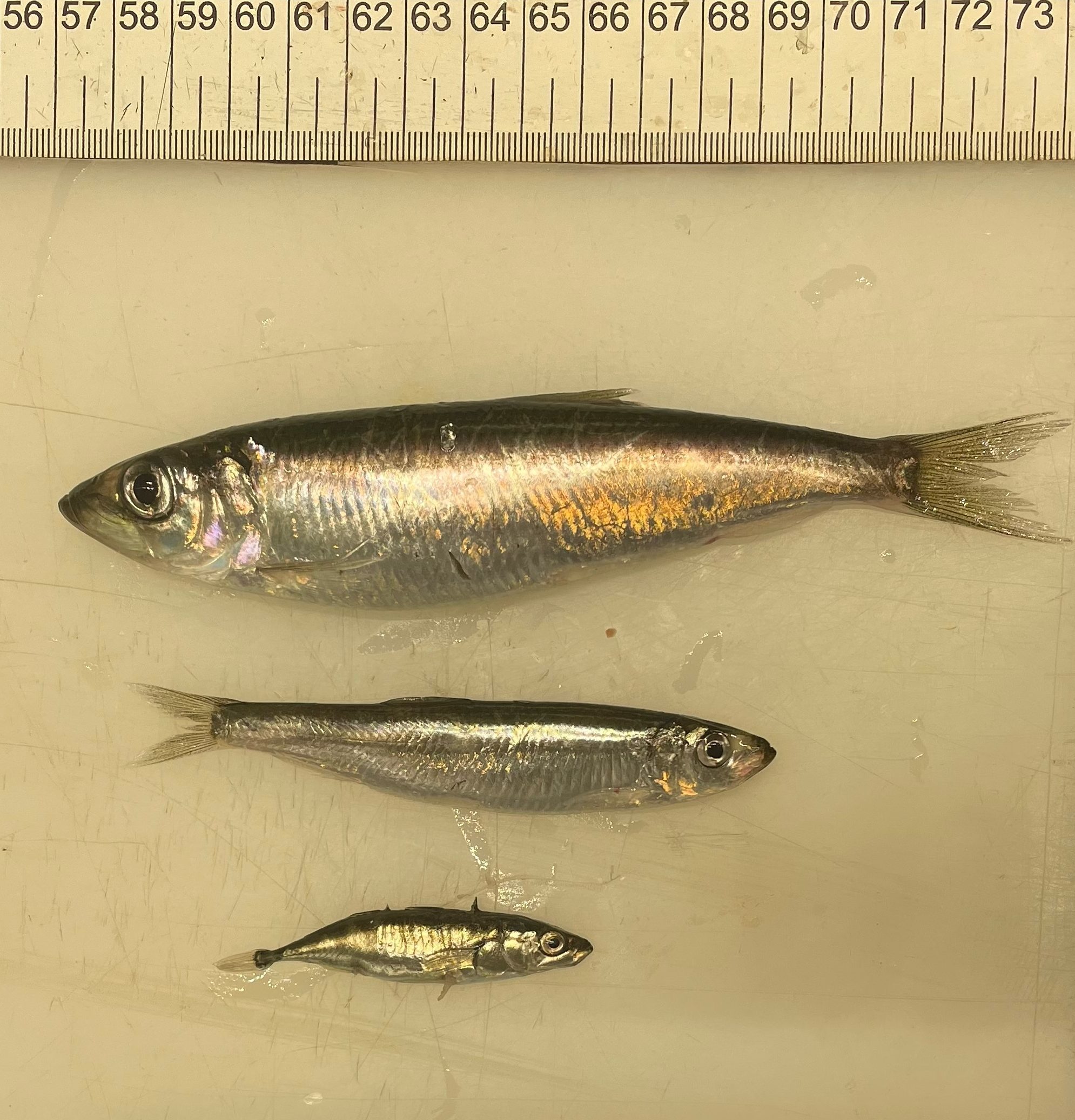
Herring, sprat and three-spine stickleback; Foto: Jan Kinlan

Just out – new paper on plankton phenology

Here we analyzed 15 yr of monitoring data to identify trends and drivers of timing and magnitude of bloom-forming phytoplankton and diverse zooplankton taxa throughout the season in the central Baltic Sea.

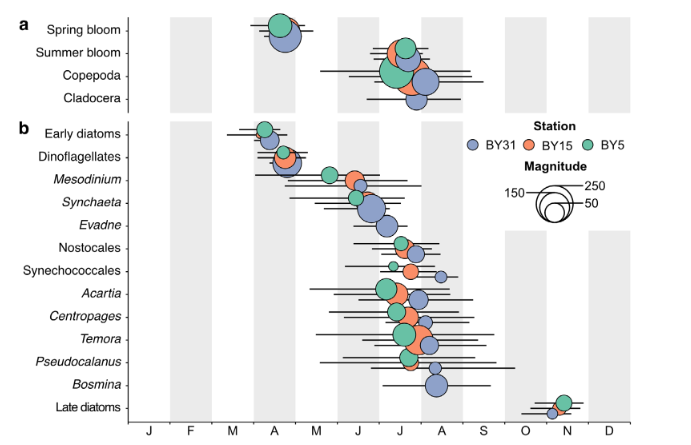
We show that the timings of phytoplankton blooms advance, whereas crustacean zooplankton seasonal timings remain constant. This increasing offset with the spring bloom is linked to the decline of Pseudocalanus, a key copepod sustaining pelagic fish production. The majority of copepod and cladoceran taxa, however, are co-occurring with summer blooms. We also find new developing fall blooms, fueling secondary production later in the season. Our study highlights that response to climate change differs within and between functional groups, stressing the importance of investigating plankton phenologies over the entire annual cycle in pelagic systems.

See also SU’s press release:

English: Earlier spring bloom disrupt the balance of the Baltic Sea

Swedish: Allt tidigare algblomningar rubbar den känsliga balansen i Östersjön

The full article is available here: Plankton blooms over the annual cycle shape trophic interactions under climate change. Limnology and Oceanography Letters

Plankton succession in the central Baltic Sea from 2008 to 2022. Seasonal timing, peak magnitude and bloom duration of (a) total spring and summer phytoplankton and total copepod and cladoceran biomass, and (b) dominating phytoplankton and zooplankton taxa. Point positions (x-axis) correspond to the average peak timing (week), point sizes to the average peak magnitude (zooplankton: μg L−1; phytoplankton: μg C L−1) and the horizontal bars to the average initiation and termination (week) of their respective growing seasons.